

The trouble with being a high achiever is that you cannot even have a breakdown without turning it into a research project.
Mine took years, cost me most of what I had built, and eventually became a company. Here is how that happened.
Performing my way out
I grew up in the Soviet Union, in a family where achievement was the only currency. It became my superpower, and it bought me an exit.
I worked for it every day. Two scholarships to the American University in Bulgaria went to students from Belarus that year, and I got one.
My mother had decided I would become a teacher. I found the business administration program instead, because I loved the energy of business. My act of defiance came with a diploma attached.
I was still an über student, so I finished a second degree in linguistics at the same time.
Then a job in Vienna, in German, a language I did not speak nearly well enough at the time. Then business school at INSEAD in France and Singapore. I applied for every scholarship available and got half my tuition covered. For the rest I needed a loan, which an immigrant in Austria does not get easily. I got it, and I went.
Ten countries and three continents later I was in Silicon Valley. I had read Richard Branson's Screw It, Let's Do It on the plane, so I did, and started my own company instead of going to work for someone else's.
A marketing agency and social club for trendsetters, producing fashion shows for famous brands and up and coming designers, with a roster that included G-Star, Betsey Johnson and John Varvatos. I walked the runway myself a few times, cheered on by friends.
For a while it felt exactly as good as it looked from the outside.
The glitch
From the outside it looked like I had made it. Glamorous events, a prestigious degree, a lot of friends. Inside, I was running on empty. The operating system I had built as a child, hoping for approval, was failing.
Then, in perfect crisis fashion, everything crashed at once. I ended a relationship, put his things outside my apartment and changed the locks. The people I had counted as friends took his side. My credit cards were maxed out. And I was burned out from a business I had stopped loving long before I admitted it. I had no idea what I would do instead.
The facade I had spent a decade maintaining came down faster than anything else I have ever built.
So I did the one thing I had been running from my whole life and asked for psychological help. A few months earlier a woman at a workshop had suggested therapy, and I was quite offended, because clearly I was not crazy. I was just busy.
The hardest project I have taken on
I brought a notebook to my early therapy sessions and took notes vigorously, hoping I would get an A plus in this too.
What followed was years of trying to understand what was actually going on with me. Hundreds of books, dozens of courses and trainings, some energy modalities I still cannot explain, and a lot of connecting the dots between all of it.
Figuring out the puzzle of me.
What kept amazing me was the gap between how capable people are and how long they stay in patterns that are clearly not working. The most impressive people I knew were stuck, and so was I. We chase success for decades without ever finding out who we are without it.
Every modality I tried was good and every one of them had a hole in it. Therapy looked backward, which is how I understood what had happened to me, and it had nothing to say about what I should build next. Coaching looked forward, which I needed, and it had very little curiosity about what I was carrying into the room and how it was still running my life.
So I did what a strategy consultant does. I took what worked from all of it, cut what did not, and rebuilt it into something that actually functioned.
It never got left at the airport
What I found underneath all of it was identity. Not a fixed self waiting patiently to be discovered, despite what most of us believe, but architecture. Behavior sits on top of it, which is why behavior change on its own does not hold.
I had changed my countries, my jobs, my wardrobe and my relationships, and my identity came with me every time. It never once got left at the airport.
Once I saw it in myself I started seeing it everywhere, in the founders and executives I was mentoring, and specifically in the ones who looked the most put together.
What limits people is almost never capability. It is whether they are in charge of their identity, or it has been in charge of them the whole time.
Back to school at forty
In 2016 I started mentoring startups. Founders came to me to solve business problems, and the session would almost always end up being about them, and about why they had started the business in the first place.
My own years of figuring out the puzzle of me let me go past the business frameworks and see the person in front of me.
Somewhere in there, a founder I was advising on marketing told me at the end of a session that it had been really therapeutic. I took it as a sign.
This was my next chapter, so I went back to school. Harvard first, then advanced executive coaching training taught by a director of coaching at Google. I took notes there too.
Beginner again, twice over, and this time on purpose.
What I built next drew on all of it. Strategy consulting, marketing, and now psychology, which took five years of emotional work.
I called it Connected Method, because that was the whole idea: connecting the human to the business, the marketing to the person doing it.
By 2019 I had a business built around it, running the work one to one, in groups, and in workshops around the world. I have mentored founders at Techstars in San Francisco and taught entrepreneurship at INSEAD, and hundreds of founders and executives across forty countries have used it since.
Nobody chooses their identity
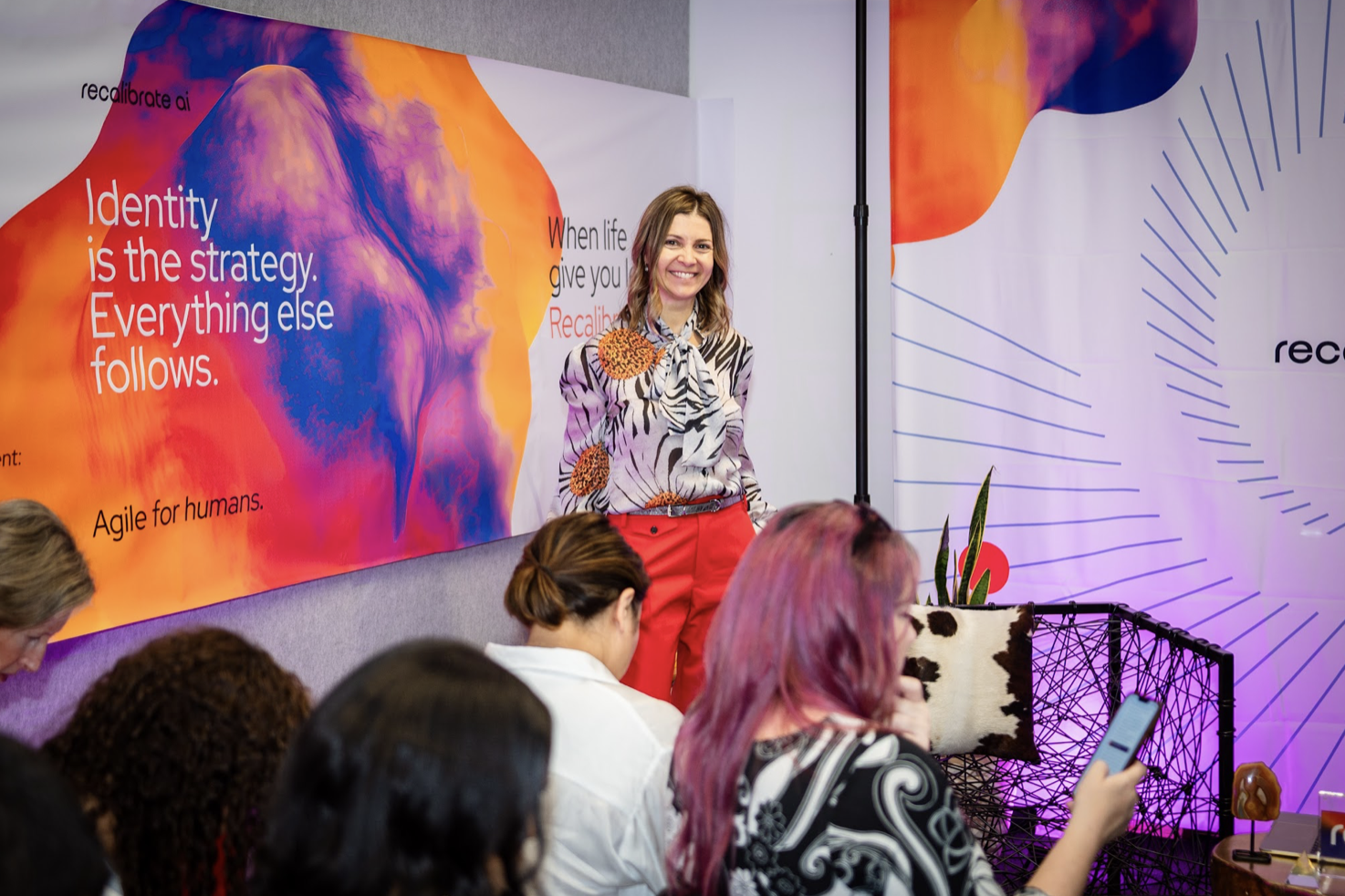
Recalibrate AI Launch. April 2026
Connected Method became Recalibrate, because by then the work was not just about connecting things, but adjusting the architecture underneath.
Out of that came Identity Strategy, the category I have spent the last several years building, and Recalibrate AI, the Identity Platform I am building it into. From my own experience I know how much it matters to have support in the moment the old pattern fires, and not once a week.
Nobody chooses their identity. It gets assembled early, out of what your family rewarded, what your industry expected, and whatever got you through the first real crisis of your career at twenty-five. Then it never gets revisited. At some point it stops being a description of you and starts being the thing making your decisions without telling you.
Identity Strategy is what happens when you go back and build the next version on purpose.
Where you are, where you want to be, and what would have to be true about you to get there. The same questions anyone would ask about a business, asked about the person running it.
The goal is to be the author of your own life, and to take your worth from the inside instead of from the last thing you achieved. That is what I call being self-full.
Always recalibrating
I am still a recovering overachiever. I work hard, but now it is work I enjoy. I choose my own trajectory, feel good about the decisions, and know I can change direction when I need to.
I spend my days building something that did not exist before, and helping people make the shift I had to make without a map.
The quality of my life and of my work is on a completely different level than it was at the time of that perfect crisis a decade ago. I am married to a man who told me early on that my goods are good. There is a dog named Vega, who lent her name to the AI companion we are building. There are sunset hikes and long dinners. And there is a relationship with myself that I did not have before, which took the longest of all of it.
Always recalibrating, by choice.
Liana Habicht is the Founder and CEO of Recalibrate AI and the creator of Identity Strategy. She works with founders and executives one to one.